Leonard Hjalmarson, DMin
It’s survival in the city
When you live from day to day
City streets don’t have much pity
When you’re down, that’s where you’ll stay. (The Eagles, 2003)
The classic Eagles song tells one side of the story. Urban life is the reality for most Westerners now. In Canada 82% of our citizens live in cities. William Cronon notes that for many of us cities have “represented all that [is] most unnatural about human life… a cancer on an otherwise beautiful landscape” (Cronon1992, 17). This dualistic view has the negative effect of limiting creative and redemptive engagement in our urban places. A more nuanced engagement is needed. Soul of the City is a move in this direction.
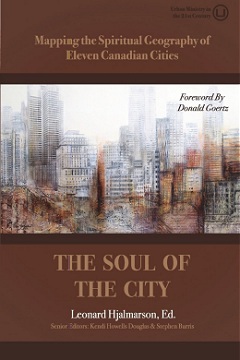 Roughly two years ago I was musing on these issues with a friend, and we were wondering why there was so little sustained dialogue around urban realities in faith circles in Canada. It turned out there were many people reflecting on urban issues, but they were largely siloed and not networked. I realized that my network of connections, established through the years by my active blogging life, could be leveraged to add a few more voices to the conversation.
So I began beating the bushes. The challenge was to locate thoughtful writers in major Canadian cities who had the heart and the will to contribute a chapter. We gathered twelve theological practitioners to reflect on the spiritual topography of their city. This is spiritual geography and topographical exegesis, phenomenology and urban ethnography. It is exegesis relative to spirituality, hope, change and transition, globalization, justice and civic design. How do these components together contribute to a social and spiritual imaginary? What impact on spiritual life does gentrification, immigration, and religious pluralism generate for urban Canadians? How have our relationships to our original peoples impacted the hope of shalom in urban life? How do these attitudes, ideologies, histories, and present forces impact the spiritual climate of a place?
The cities in focus are: Victoria, Vancouver, Kelowna, Calgary, Edmonton, Regina, Winnipeg, Ottawa, Toronto, Montreal, and Halifax. These cities were selected for their representative (wide) dispersion as well as by the location of appropriate contributors. Some cities were eliminated because we lacked capable connections. We did what was possible.
Show me your city and I will show you what it is you long for. (Ward 2003, 467)
Long before Jamie Smith gave us his secular liturgies series, and asked us, “What do we love?”, Ward was speaking to our collective soul. We want to love our cities; we want them to address our deep longings. Maybe that’s where our work begins. How do we build cities that lift up the human heart? The question is critical because the city, not the country, is the place where most people will exercise their “skilled mastery”[1] in this century. This moves our skilled-mastery beyond farming and craftsmanship to shaping the urban landscape. This new emphasis in skilled mastery translates into place-making[2] in the city. Jacques Ellul (1970, 44) writes,
The city dweller becomes someone else because of the city. And the city can become something else because of God’s presence and the results in the life of a man [sic] who has met God. And so a complex cacophony raises its blaring voice, and only God can see and make harmony of it.
Not only do we shape the city, but the city will shape us. Will our environment make us more human, or less? Will our urban places help us to thrive, and offer us a context for shalom, encouraging practices that make space for the Kingdom? Even in the city, place-making is determined by a master-story.[3]
The narratives which shape our cities are complex. The forces of global mapping privilege the universal in the name of profit. Graham Ward (2005) writes that, “the major issues affecting a global city are increasingly less local, or even national – they are international. This is mainly because it is an international profile that the major cities of the world are competing for in order to attract investment.” (p. 30) Thus the ability to make choices is often suspended, and transferred to multinational corporations where unelected leaders wield enormous power. Ramachandra (2006) identifies the “global village,” in the sense of a mutually enriching exchange, as a myth.[4]
Ward (2005) argues that global cities are characterized by fear and anxiety. He writes that, “The global, post-secular city [London] is the home of the migrant soul. Citizens are caught between two public narratives: the potential violence of coexisting cultural differences, and the fear of the erasure of difference.” (p. 39) He notes that both these narratives are totalitarian and depoliticizing (i.e. they do not lead to engagement). Ward (2005, 39) argues that the alternative is a “practice of living that . . . negotiates difference without assimilation.” Christians can offer the possibility of such an alternative.
Some identify tolerance as a Canadian virtue, and it is certainly an ideal to which liberal Western elites aspire. But tolerance is not a Christian ideal. Rather, our engagement is a politics of resistance rooted in a paradox. David Bentley Hart (2003, 320) frames the paradox like this: “He is not the high who stands over against the low, but is the infinite act of existence that gives high and low a place”. The essential practice is the Eucharist, which “creates space for the diversity of human voices to participate” (Sheldrake 2001, 168). The Church is an anticipation of the eschatological humanity, with the Eucharist a counter-narrative of globalization that builds the global Body of Christ in every place, with all its beautiful diversity.
I find that perspective immensely hopeful in these days when the need for love and kindness and mercy is greater than ever; when people are more divided by political ideology than ever; when we desperately need counter-narratives that help us to bridge the differences between people. So I give the final words in this post to Reinhold Niebuhr:
Nothing worth doing is completed within our lifetime; therefore, we are saved by hope; Nothing true or beautiful or good makes complete sense in the immediate context of history; therefore, we are saved by faith; Nothing we do, however virtuous, can be accomplished alone; therefore, we are saved by love. (Niebuhr 1974, v.)
REFERENCES
Cronon, William. (1992). Nature’s Metropolis: Chicago and the Great West. Chicago: WW Norton & Co.
The Eagles. (2003) In the City. Chicago: Warner Strategic.
Ellul, Jacques. (1970). The Meaning of the City. Grand Rapids: Eerdmans.
Hart, David Bentley. (2003). The Beauty of the Infinite. Grand Rapids: Eerdmans.
Levenson, Jon D. (1985). Sinai and Zion: An Entry into the Jewish Bible. Minneapolis: Winston Press.
Niebuhr, Ursula, Ed. (1974) Justice and Mercy. NY: Harper & Row.
Ramachandra, Vinoth. (2006, May 10). Christian Witness in an Age of Globalization. Leonard Buck Memorial Lecture, BCV, Melbourne.
Ward, Graham. (2005). Christian Political Practice and the Global City. Journal of Theology for Southern Africa, 123, 29-41.
____________. (2003). Why is the City So Important for Christian Theology?” CrossCurrents. 460-473.
TWO
But while we ought to live out a politics of resistance, that is not all we are. The church is not merely a resistance community. The Greek word ekklesia referenced a political body long before it was adopted by Christians. Our members occupy roles in the broader social landscape. The church thus has potential to work against the fragmentation of public and private, secular and sacred, rich and poor. Cities are often run by elites, but the church knows no such class structure, in fact it gives privilege to those without power. Thus our work in the city must also be prophetic. Let’s look at this more closely.
Surveying the Spiritual Landscape
Geography is simply a visible form of theology. (Levenson 1985, 116)
How do we get to know our cities? How do we identify the spirit of a place? What theological and social frameworks will contribute to our understanding? We have begun to sketch these above, but our theological frames are likely to be diverse, shaped by the contexts and traditions which shape us, and so the complexity of our analysis becomes uniquely dialogical and contextual.
We can reflect on a particular place in terms of what we may call the spiritual geography, extending the theological task into an exploration of how context impacts faith. We use the word “context” to describe a particular environment, including, but not limited to, the physical dimensions.[5] We include the historical, economic, social and cultural factors. Not only does context impact belief but also it provides a window (perhaps, an “imaginary”) through which one may relate to God. Moreover, the rise of virtual and networked space complicates context. The authors of Networked Theology remind us that “geography becomes irrelevant as time-space barriers dissolve.” (Campbell & Garner, 2016, p. 89)
When we extend the theological task to discern the spiritual geography of a place, we highlight the interweave of attitudes and environment, postures and politics, and the ways this interweave calls to the spirit or denigrates it. These things are commonly felt as intangibles, and are difficult to identify and articulate. Theology is a reflective task because it asks questions and makes statements it cannot understand. It’s the nature of the craft. But our work helps us evaluate the human environment at levels that are more than merely phenomenological. It contributes to the richness of a spiritual vocabulary rooted in the rough and tumble of life, “sails and ships and ceiling wax” (Carroll, 1872). It is not just holy places which inspire us, but places which inspire us to become holy: they transform our human journey into a pilgrimage.
Linda Mercadante (2004) warns that discerning the spirit of a place could be reduced to a vague delineation of how a place is or is not conducive to human flourishing. She offers two safeguards to this tendency. First, the awareness that God is continually trying to reach us, to break through our defenses, and to offer divine grace. Second, as Calvin stressed, that God accommodates to our condition. “Our particularity creates the need for God to come to us in ways we can understand, and . . . God has the consummate ability to do this” (Mercadante, 2004, p. 62).
The most fundamental way God has met us is in the Incarnation. The Incarnation combined the human and divine, matter and spirit, and was preeminently a phenomenon of spatiality. Jesus was placed, a first century Jew meeting us in place and time. This may cue us to some important questions relative to our urban contexts. The physical space of our humanity is not just flesh and blood, but also steel and glass. Our bodies do not interact socially apart from physical places (though digital technology is a new kind of mediation). And in the nature of culture itself, our bodies participate in both a natural environment and cultural artifacts, so that the city is more than mere container, as place is more than space. The city is us.
There are a few other things to consider as you seek to understand your city. The city remains both graced and fallen. In his chapter in this book Rob Crosby-Shearer notes of Victoria that there are “shadows in paradise.” Later in this book, Cory Seibel describes the darker “frontier” realities of Edmonton noting that these are “acute manifestations of phenomena that occur across the life of the city.” Each of our cities needs this kind of nuanced mapping.
We can provide our cities with this assisted by the social critique of writers like Zizek, Baumann, and Chomsky. In Zizek, for example, the “both/and” experiences in our cities are called “irruptions.” This enables him to move beyond the external psychological sign of an inner disturbance in his discussion of social symptoms (Zizek, 1989).
For Zizek, a symptom can work within a culture to expose an unfulfilled drive, the unspoken void around which that culture has been formed. “An image, an explosion of media activity surrounding an event, a popular movie, a flurry of publishing can expose something hidden and unspoken that drives a culture’s meaning system” (Hesiak, 2007). What we see and hear on the surface may be compensations for what the culture itself lacks at its core. Exposing these kinds of Zizekian symptoms in our cities opens them up for change and transformation.
For Zizek, cultural symbolic orders exist to legitimize something; as such they are ideologies. These meaning systems mask an absence which no one wants to face. So every cultural system is prone to “irruptions of the Real” which reflect back to its participants what is hidden within the ongoing system of meaning. Thus the homeless populations amidst capitalist societies reveal the immanent logic of the politic of capitalism. This is poignantly clear in the chapter in this book penned by Spurgeon D. Root and Nick Helliwell, but features in a number of chapters in this book. Capitalist ideology may say that its goal is to rid humanity of all poverty, but Zizek would suggest that the homeless person reveals the true drive behind capitalism, the way it plays upon the fear of poverty and the fear that we all might become homeless if we don’t work harder. Global capitalism is a force that impacts the soul of every large Western city, and its symptoms are available to any observer.
Finally, it’s important to keep in mind that, while the city has always been amenable to new technologies, digital culture and new media are impacting our communities as never before. To the extent that these expressions of connectivity work against our neighbourly relationships they may act as a solvent to social capital. But the knife cuts both ways. To the extent that new technologies empower connection they may also lead to renewed civic engagement, a richer expression of the soul. The role of Twitter in the Occupy movement, as in the Arab Spring, are cases in point. Social geographers watch these developments with interest. Private space and public space are giving way to something like connected space, the in-between land of the other city that never sleeps: the Internet.[6] The soul of the city is also found in virtual space.
Thirteen Practitioners
“Walkers are ‘practitioners of the city,’ for the city is made to be walked. A city is a language, a repository of possibilities, and walking is the act of speaking that language, of selecting from those possibilities.” (Solnit, 2000, p. 8)
We have gathered thirteen theological practitioners to reflect on the spiritual topography of their city. These writers each contribute one chapter of five thousand words on the place they live. This is spiritual geography and topographical exegesis, relative to spirituality, hope, change and transition, globalization, justice and civic design. How do these components together contribute to a social and spiritual imaginary? What impact on spiritual life does gentrification, immigration, and religious pluralism generate for urban Canadians? How have our relationships to our original peoples impacted the hope of shalom in urban life? How do these attitudes, ideologies, histories, and present forces impact the spiritual climate of a place?
The cities in focus are: Victoria, Vancouver, Kelowna, Calgary, Edmonton, Regina, Winnipeg, Ottawa, Toronto, Montreal, and Halifax. These cities were selected for their representative (wide) dispersion as well as by the location of appropriate contributors. Each contributes based on their own experience and expertise and their particular inhabitation of the place they live. Consequently, there are broad differences in the way they address the life of their city and its hopes and dreams, its failures and fears. As a collective we offer this book to you as a conversation on the rich spiritual geography of Canadian urban life today, in the hope of renewed and enriched engagement in the welfare of the peoples of Canada.
List of Contributors, from West to East
Professor Donald Goertz, Foreword
Dr.Leonard Hjalmarson, Introduction
Rob Crosby-Shearer, Victoria
Ross Lockhart, Vancouver
Paul Martinson, Kelowna
Dr. Cory Seibel, Edmonton
Dr. William McAlpine, Calgary
Spurgeon D. Root and Nick Helliwell, Regina
Jamie Howison, Winnipeg
Dr. James Watson, Toronto
Dr. Richard Long, Ottawa
Dr. Domenic Ruso, Montreal
Dr. Gary Thorne, Halifax
REFERENCES
Campbell, Heidi A. & Garner, Stephen. (2016). Networked Theology: Negotiating Faith in Digital Culture. Grand Rapids: Baker Academic.
Carroll, Lewis. (1872). “The Walrus and the Carpenter.” In Through the Looking Glass. London: 1871.
Cronon, William. (1992). Nature’s Metropolis: Chicago and the Great West. Chicago: WW Norton & Co.
The Eagles. (2003) In the City. Chicago: Warner Strategic.
Ellul, Jacques. (1970). The Meaning of the City. Grand Rapids: Eerdmans.
Hart, David Bentley. (2003). The Beauty of the Infinite. Grand Rapids: Eerdmans.
Hesiak, Jason. (2007, November 1). “Zizek and Evangelicals in America.” Retrieved from
http://churchandpomo.typepad.com/conversation/2007/11/zizek-and-evang.html
Keller, Tim. “The City.” (2009). Retrieved from https://vimeo.com/3497788
Kostof, Spiro. (1991). The City Shaped: Urban Patterns and Meanings Through History. Oakland: Bullfinch Press.
Levenson, Jon D. (1985). Sinai and Zion: An Entry into the Jewish Bible. Minneapolis: Winston Press.
Lynch, Kevin. (1960). The Image of the City. Cambridge, MA: MIT Press.
Mercadante, Linda. (2004). Tasting the Bitter with the Sweet. In Kathryn Tanner (Ed.), Spirit in the Cities (pp. 47-68), Minneapolis: Fortress Press.
Project for Public Spaces. (2012). “Creativity and Place-Making: Building Inspiring Centers of Culture.” Retrieved from
https://www.pps.org/reference/creativity-placemaking-building-inspiring-centers-of-culture/
Ramachandra, Vinoth. (2006, May 10). Christian Witness in an Age of Globalization. Leonard Buck Memorial Lecture, BCV, Melbourne.
Sheldrake, Philip. (2001). Spaces for the Sacred. Baltimore, MA: Johns Hopkins University Press.
Solnit, Rebecca. (2000). Wanderlust: A History of Walking. New York: Penguin Books.
Ward, Graham. (2005). Christian Political Practice and the Global City. Journal of Theology for Southern Africa, 123, 29-41.
____________. (2003). Why is the City So Important for Christian Theology?” CrossCurrents. 460-473.
Zizek, Slavoj. (1989).The Sublime Object of Ideology. London: Verso Books.
[1] A translation of the Hebrew word radah in Genesis 1.
[2] Place-making is a sub-set of vocation is part of God’s redemptive mission, and something we all do, often transparently. When we build, or paint a building, or plant trees, or decorate a coffee-shop, we are place-making. Caring for the environment is also an expression of place-making, and working for justice can be another.
[3] An over-arching narrative of the kind post-moderns are not fond of.
[4] Graham Ward argues that one answer to the depoliticization of politics is the practice of cultural hermeneutics: the analysis, examination and interpretation of cultural practices.
[5] I particularly value the work of two writers in this area: Clifford Geertz and his book Local Knowledge (Baker, 1983) and Clarence Sedmak, Doing Local Theology (Orbis Books, 2002)
[6] The authors of Networked Theology (2016) describe “publicized privacy” and “constant contact” as part of the ambiguous nature of connective technologies. “Information ecology” now undergirds any real places we occupy.
 Urban Loft Publishers